UP YOUR DOG SHOW GAME
Helping Breeders &
Exhibitors Succeed in the Show Ring
HANG IN THERE!
Handling Dogs If You Are
Physically Challenged
by Christine Ward-Weber
“Whether you have bad knees, hips, or something more, do not let others steal your passion. Find a mentor, find a way and hang in there. It is about the dog, and it is worth the hours.”
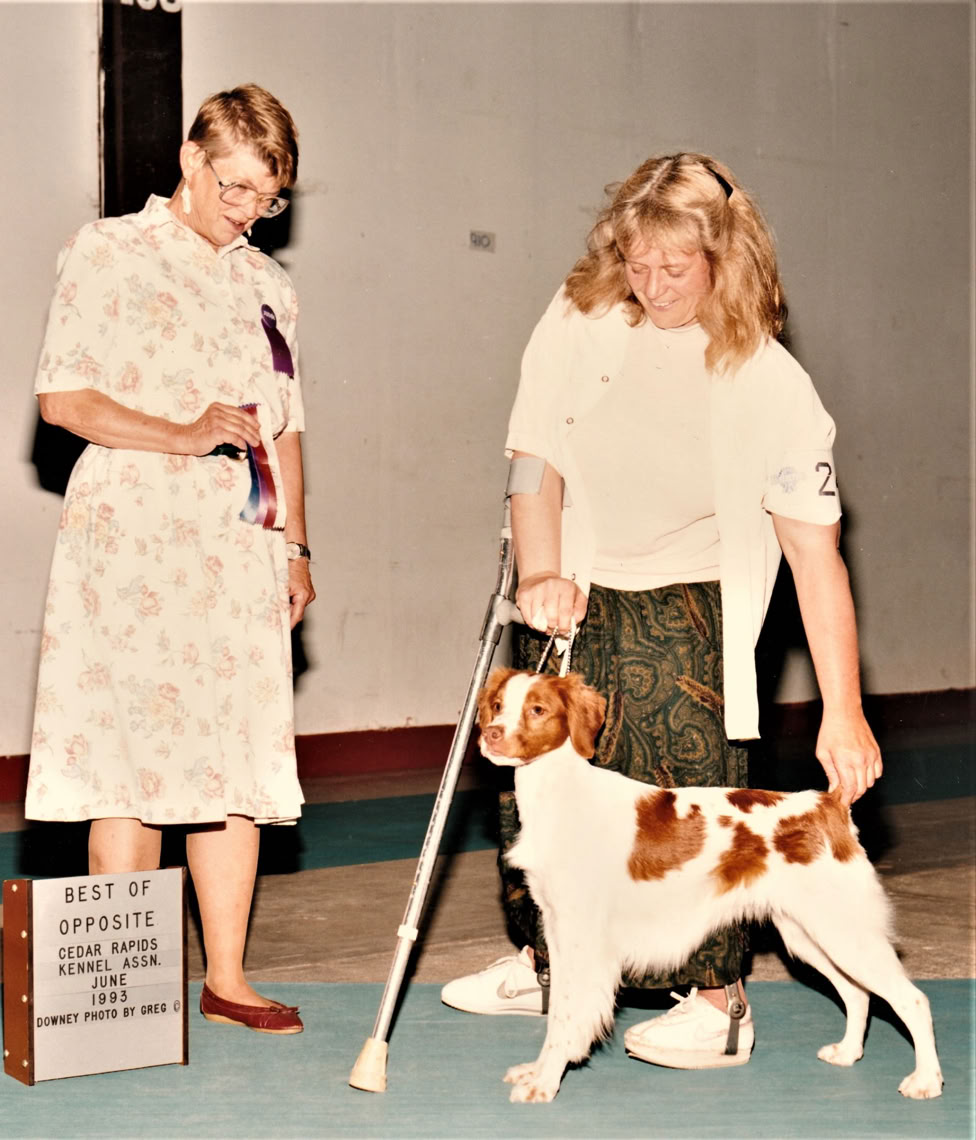
Where do I begin to explain to those with physical challenges how to begin a show career with your dog? First, let me say that it will not be easy for you or your dog. I raise, train, and show Brittanys, and have successfully exhibited in the Conformation & Obedience rings at all levels for 40 years. Here is my story.
As a child, I contracted polio and, as a result, I use crutches. I never realized while growing up that I was much different than anyone else and there was nothing I felt I could not do if I wanted to. In my mind, limitations were just not there.
I fell in love with dogs as a child, but I was not part of a family that embraced dogs. I remember seeing illustrations from Walter A. Weber and thinking, “I want one of those, just like the ones he painted.” As a child, I used to have my mother drop me off at the Quad City Dog Show on Mother’s Day. I was in awe of the Brittanys. They were beautiful. I thought, “That’s what I want,” so I chose my breed. I bought my first Brittany from Field-Trial stock, since it was all I could afford at the time,, and it gave me my introduction to the breed's challenges but did not get me into the show ring. She was just not that dog. She failed 3 obedience classes, taught me why a crate is needed, and opened my eyes to what great hunters Brittanys truly are. So, after deciding what direction I wanted to go, I purchased my first competitive show Brittany in the late ’70s from a well-known breeder. Evansport’s Brandy Wine was my first AKC competition Brittany. She became a multiple BOB winner & group placer, in addition to earning her UD, but these accomplishments were not easily earned. Fortunately, I started in Obedience. I was not totally sure I could conquer the show ring, but I eventually did, and here’s how I went about it.
I had help, and lots of it, so I could find a way to handle my own dog. First, I had to figure out how to get a Brittany to gait with me, what length lead I needed, and how I could control the position to allow my dog to move correctly. I had to figure out what the dog could do to make my job easier and train her to help. To show dogs on crutches, I needed another set of eyes to help me get this figured out. Along came Teresa Richmond, a then-assistant handler, who was one of the few who believed this was doable and that I could handle it. Hours were spent with Teresa, adjusting lead lengths and figuring out where my dog needed to be in relationship to me and exactly what I needed to do to show her at her best. Teresa was my mentor. My breeder was not so sure about my ability to be successful in the show ring, and he encouraged me to put a handler on her, so I tried that approach first.
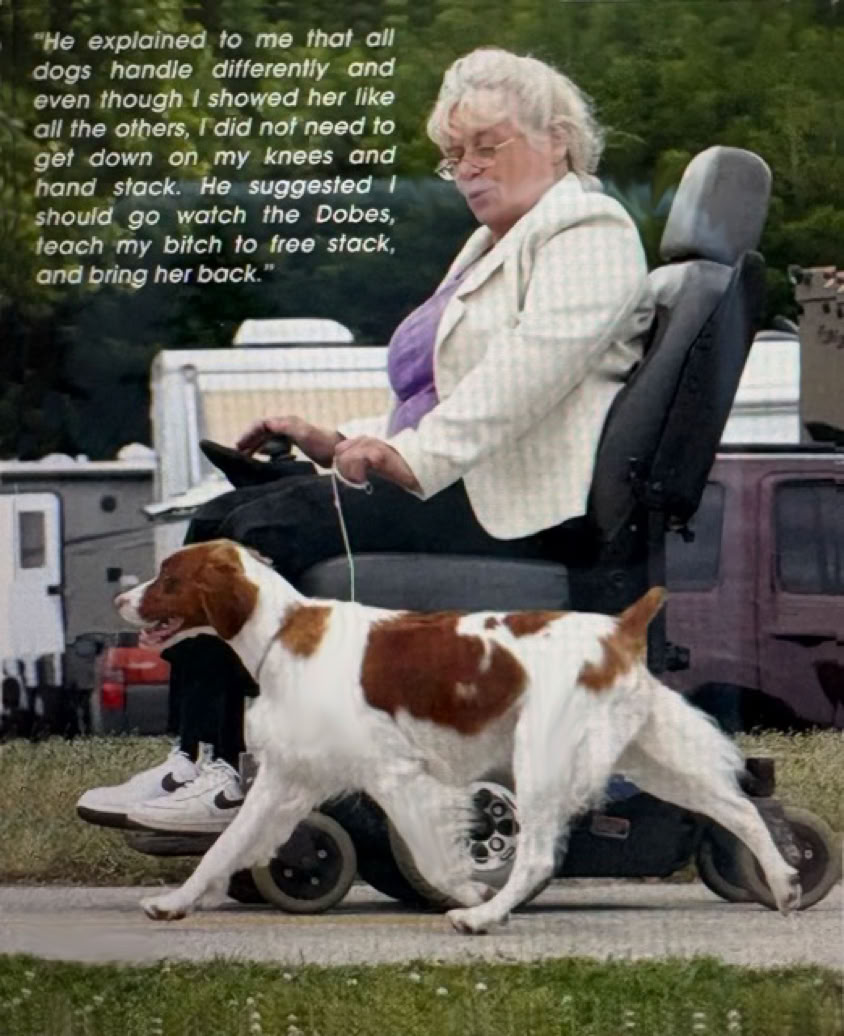
I watched my bitch trash the handler by spitting out bait and generally being naughty, so I stepped back in. At this point, I had a CDX on her, so I knew I had a degree of control. It just so happened that my handler had a ring conflict, so, in jeans and a flannel shirt, I said, "Here we go," and took the lead. It was a major that day, a typical snowy day in Milwaukee, when I gave it my best shot and earned reserve winners bitch! I was so proud that this was where the story really began. I waited all day for the judge to complete his assignment, and then I asked him two crucial questions that changed everything: (1) what more do I need to do for you to see her, and (2) does she need a handler? With the true spirit of sportsmanship, and recognizing my passion, he very respectfully told me how to improve my showmanship. He explained to me that all dogs are handled differently, and even though I showed her like all the others, I did not need to get down on my knees and hand-stack. He suggested I watch the Dobes, teach my bitch to free-stack, and bring her back. In response to my question about needing a handler, he said, "No, she is too nice; you can do it." From that point on, sharing remained on my lead and was finished before I could show her to him again. That brief conversation was a turning point.
I believed that judges could judge my dog if I could find a way to show them. I have always realized my dogs are NOT as easy to judge as others, but should be able to win if they are the best dog. I believe then, and I believe now, that it is a judge's job to use the BEST dog, not necessarily the easiest to find. Showing on crutches required a lot from the dogs. They had to know what I wanted, how to move, and how to give me the most I can get from them to make my job easier. It is not always perfect. There have been days when we were not a real team; at the end of the day, with training, lots of training, determination, and a dog who cared enough about me, we became winners in the show ring! I evolved into a breeder–handler and eventually became a mentor to others, but oh, the challenges! Just a couple of things I found most problematic were the need to watch for water or dog hair on the floor so my crutches didn't slip and ring mats without enough room for both crutches and the dog. The falls were many, sometimes even rated by fellow competitors, and it never seemed even to help with a sympathy win. LOL!
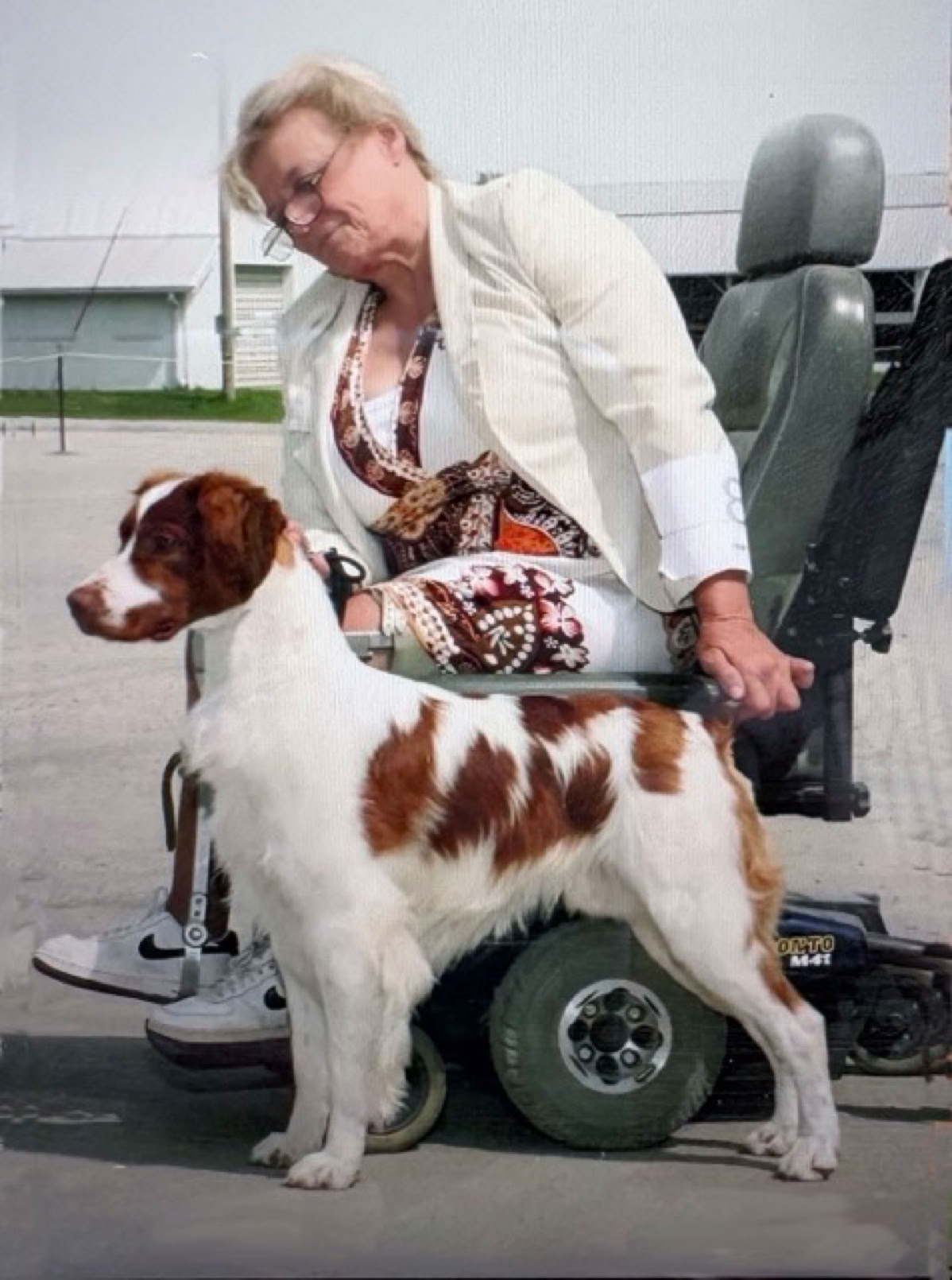
As usual in life, time changes things. After 30 years on crutches and after some back surgery, my shoulders could no longer handle the turns in the ring, so I had to employ a power chair, bringing a whole new challenge. Really folks, this is difficult! It looks easy, but trust me, it's a whole new game. I had to find a power chair that goes fast enough to get the dogs into a correct gait yet stops quickly enough that I don't run down the judge. It also must corner without slowing down, so the dog doesn't pace on the turns, and let's talk about loading! You must navigate a gravel parking lot, often getting stuck on even ground, and watch those curves! After you get over the obstacle, you then need to convince your dog this will all be OK. Folks, this is not an easy task, although it is much easier to load and unload crates.
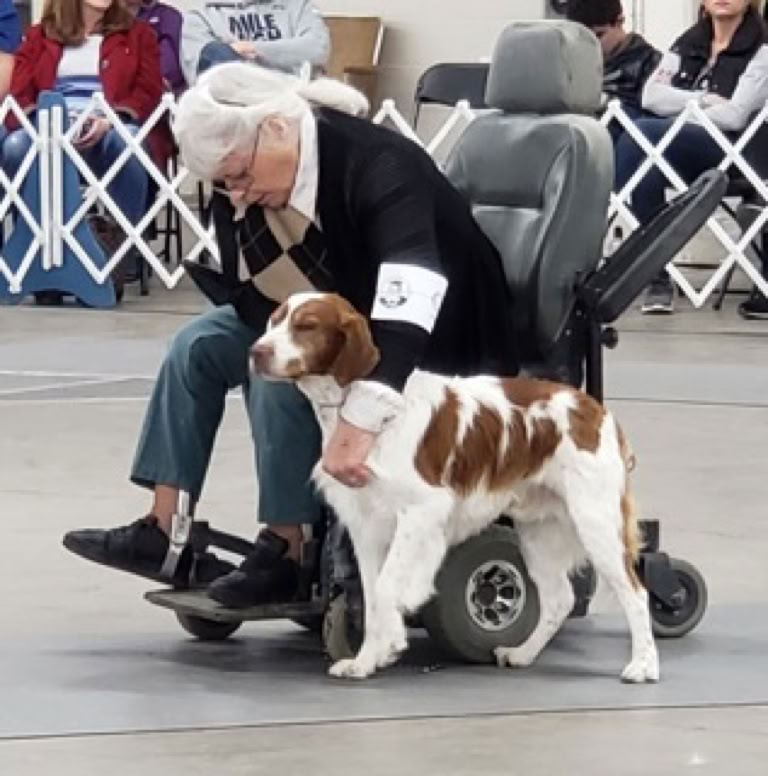
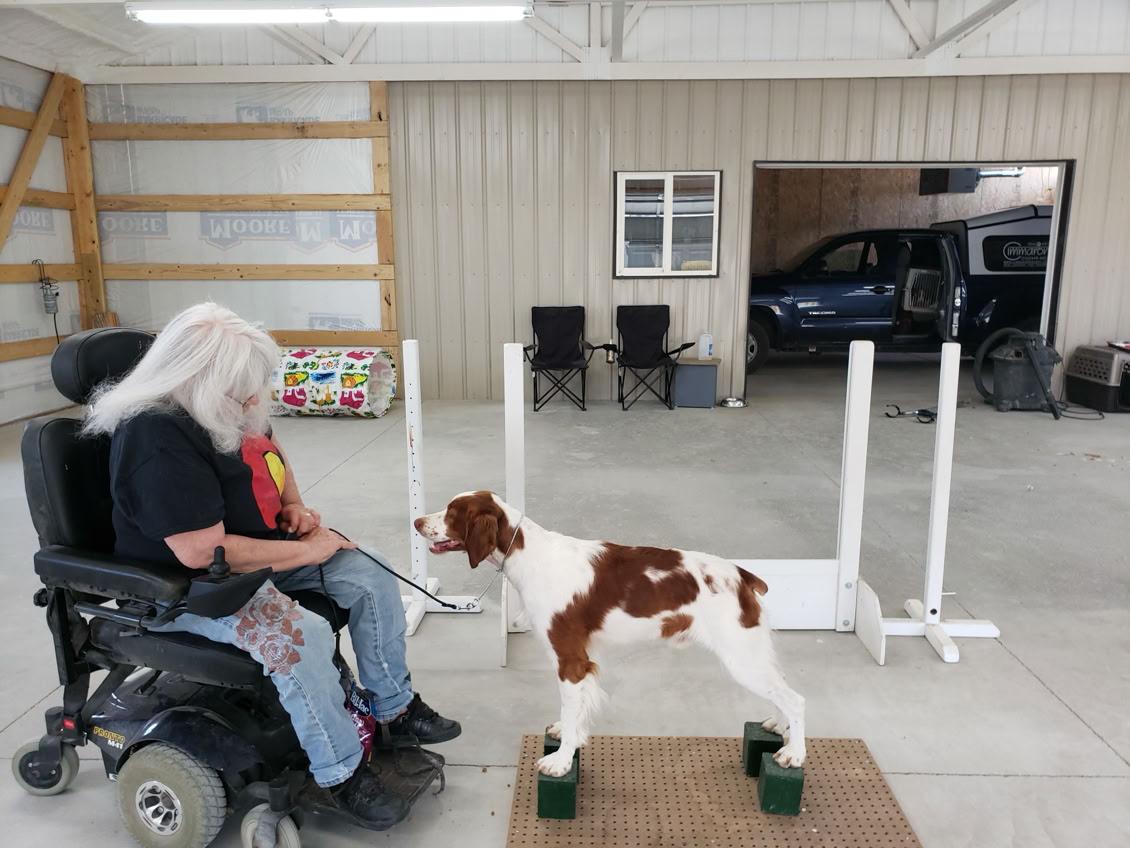
There are just some adjustments you need to make when showing with a power chair that you need to be aware of before you show. For instance, if you own a table dog, you need to be able to lift your dog on the table and off the table. For floor dogs, you will find you are now stacking them on the side at an angle, making it harder to steady them, as you are stacking them from the side instead of from above the dog, and you must convince them, when stacking, that they are where you need them to be. You could free-bait through this, but rings are often too small with a power chair or scooter to allow adjustments to correct a foot or to step to pull them forward without interfering with another exhibitor's dog. In most cases, the ring matting puts your dog on slick concrete because you need to be along the ring gates to give your dog room to gait. The ramp is another challenge since you are too low to stack them as you normally would, so you are stacking them like they are waist-high. When showing the bite, both hands need to come off the dog to present the bite, so you hope they will stand still. Now you need a hand on the lead and one on the tail. To manage these changes, you must train, train, and train some more.
I have been blessed with many wonderful, beautiful sound dogs who gave me their all. I have friends who help me fine-tune my dogs and my skills. I've been able to earn multiple obedience titles, and I've seen our Duels complete in the field. Everyone out there has some limitations; mine are just more visible than most. (Thankfully, I never wanted to play tennis!) Dogs belong in your heart, and you are in theirs. I always compete as I have in the past, as a breeder who believes in our dogs and the abilities they have. I believe in the breeder-owner-handler. Today, I have a new puppy under my desk as I write, looking to love me, no matter the challenges. I have been fortunate to find people who believe in me and my dogs so that I could find a way.
Whether you have bad knees, hips, or something more, do not let others steal your passion; find a mentor, find a way to hang in there. It is about the dog, and it is worth the hours. Have fun, believe in your skills, believe in your dog, and choose to be an owner-handler.
First published April 24, 2018, in The Canine Chronicle. Permission to reprint given by the publisher.
About the author: Christine Ward-Weber
"Chris was a personal friend and an amazing woman who over came the challenges of having polio as a child. She was very active in the conformation and obedience rings with her Brittanys having breed 100 champions over the course of her life. Sadly, she passed away after having a stroke at the Terry-All Kennel Club show last year. The 2026 American Brittany Club Summer Specialty and Skyline Brittany Club Specialty Show both dedicate their specialties to her memory at the Greeley Kennel Club shows in Colorado on August 14 -17th, 2026." -Deborah McKenna