
UP YOUR DOG SHOW GAME
Helping Breeders &
Exhibitors Succeed in the Show Ring
GREAT QUESTION
UP YOUR DOG SHOW GAME
Helping Breeders &
Exhibitors Succeed in the Show Ring
GREAT QUESTION
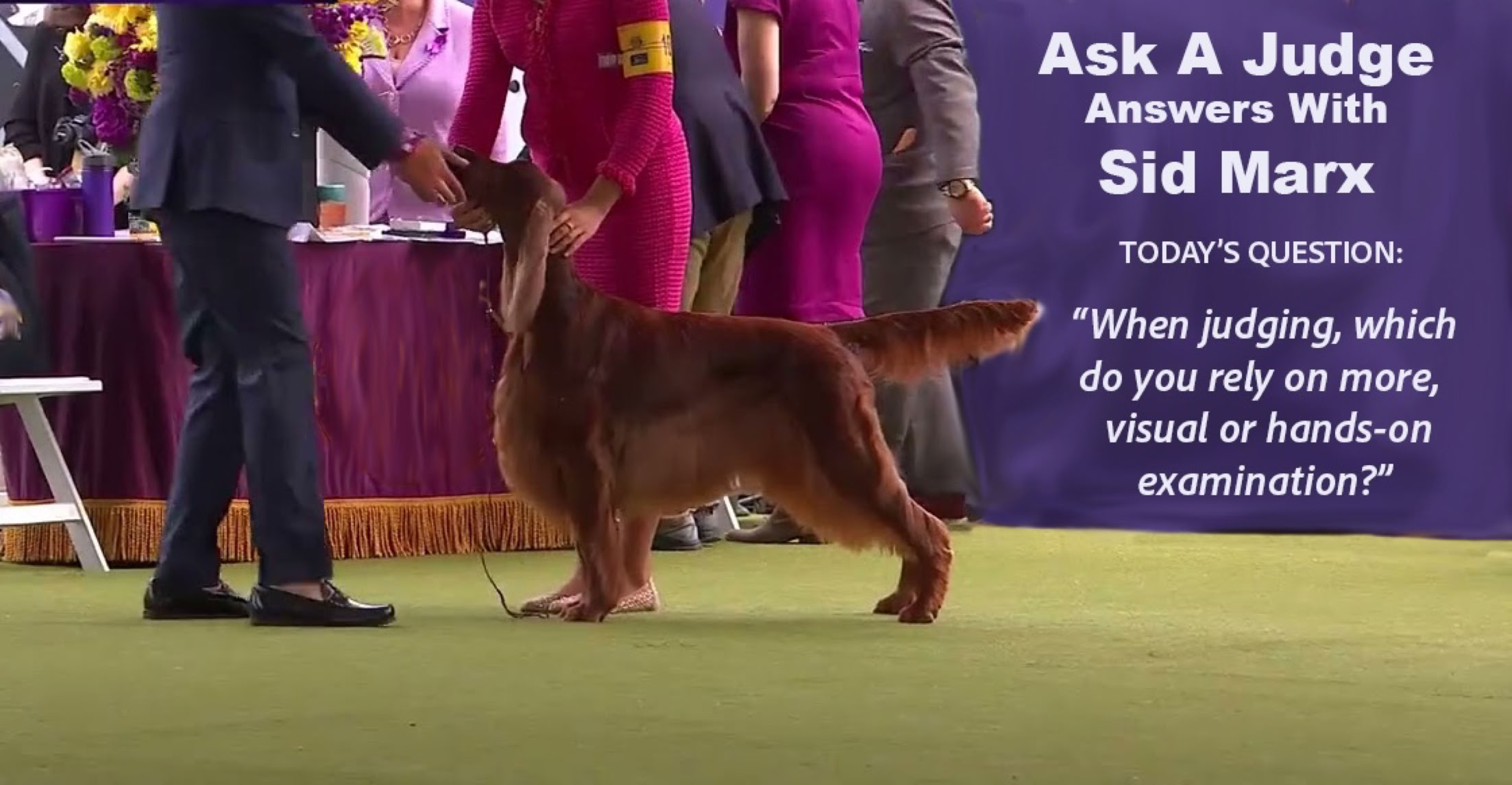
This is a very interesting question. For me, there is no either/or answer. The correct answer is both, but whether it is hands-on or visual changes as I judge the class.
When a class first enters the ring, I always walk down the line, getting a quick impression of expression and heads. To be honest, I am also looking to see if there is a dog that may prove to be a problem because he is frightened or unsure of himself. Then I step back and take a quick overall look. So, visually, I get an early impression of each dog. I think as I go through a class I am subconsciously placing the dogs and this is a starting point. I then move the class around -one at a time – to the area where I will examine them. So again, visually, I am getting an early impression of each dog, and I file it away with my early impression.
As I examine the dog, my mind (yes, I have one) is working through the breed standard and comparing this dog to that. Naturally, I start with the head. There have been times that I have been called a head-hunter, and I do not agree with that opinion, BUT in order for Dog A to be a representative of Breed A, does it not have to at least have a head similar to that described in the standard? Can an Irish Setter be a good Irish Setter if it has a head that is Broad in Skull (Golden Retriever) as opposed to Long and Lean (Irish Setter)? I cannot award an Irish Setter with a Golden head. If that makes me a head-hunter, so be it!
Also, anatomically, I am feeling to determine shoulder layback, chest depth and length, how much prosternum, rear angulation, tail-set, topline, and hocks (well letdown and parallel?). Now my hands (and eyes) have given me information on this dog. This is where the difficult trade-off starts. My hands have told me how I expect the dog to move. But very often the movement does not match what I felt physically. What do I do now? I have to decide if the poor movement is due to lack of musculature (which is a negative), or is it because the handler is inhibiting what the dog should be able to do.
On the other hand, a dog may move better than I expected, and I have to factor that in. A dog that is straight in front and straight behind may move decently. Is this better than a dog with the proper structure and angulation who does not move as well? Which one would you want to use in a breeding program? Isn’t that why we are doing this?
There have been times that I believe a dog is so much better than what I see in his movement because his handler is unable to keep up with the dog and is constantly tugging back on him, but this has to be an exceptional dog. Under normal circumstances, I have to reward what I see on that day. Do I reward Dog B whose physical examination told me that he was not as good as Dog A, but he moved better than Dog A – even though I believe it is because of the handler? What if Dog A’s examination was good, his movement fair, but his temperament (shy-backed off – did not really want to be examined, but I was able to do so)? Certainly, temperament is part of soundness – is it not? Some breeds allow for aloofness, while others do not. This has to be added to the equation.
So, the data obtained by my physical examination and what my eyes tell me go into my mental computer – and trade-offs are considered. What is more important for the breed standard? What is the breed’s purpose and how is what I am seeing – and what I felt – fit that standard?
As I said, it is not an either/or decision – it is the combination of physical examination, visual considerations – and what my mind and experience tells me about the breed – and the dog in front of me.
I hope that helps and does not muddy the situation even worse. Enjoy your dog.
I would like to once again offer a GREAT BIG THANK YOU to judge Sid Marx for helping exhibitors understand how the combination of physical examination and visual considerations are both equally important while judging.
If you would like to hear more from judge Sid Marx, check out his articles in his Dog News column, The Judge Marx The Spot. A must read of his is appropriately titled Just The Facts? -Who's at fault? Breeders? Judges? Exhibitors? Read it at: https://dognews.com/sid-marx-asks-who-is-to-blame-breeders-judges-exhibitors
SHARE US WITH YOUR FRIENDS ON FACEBOOK