
UP YOUR DOG SHOW GAME
Helping Breeders &
Exhibitors Succeed in the Show Ring
GREAT QUESTION
UP YOUR DOG SHOW GAME
Helping Breeders &
Exhibitors Succeed in the Show Ring
GREAT QUESTION
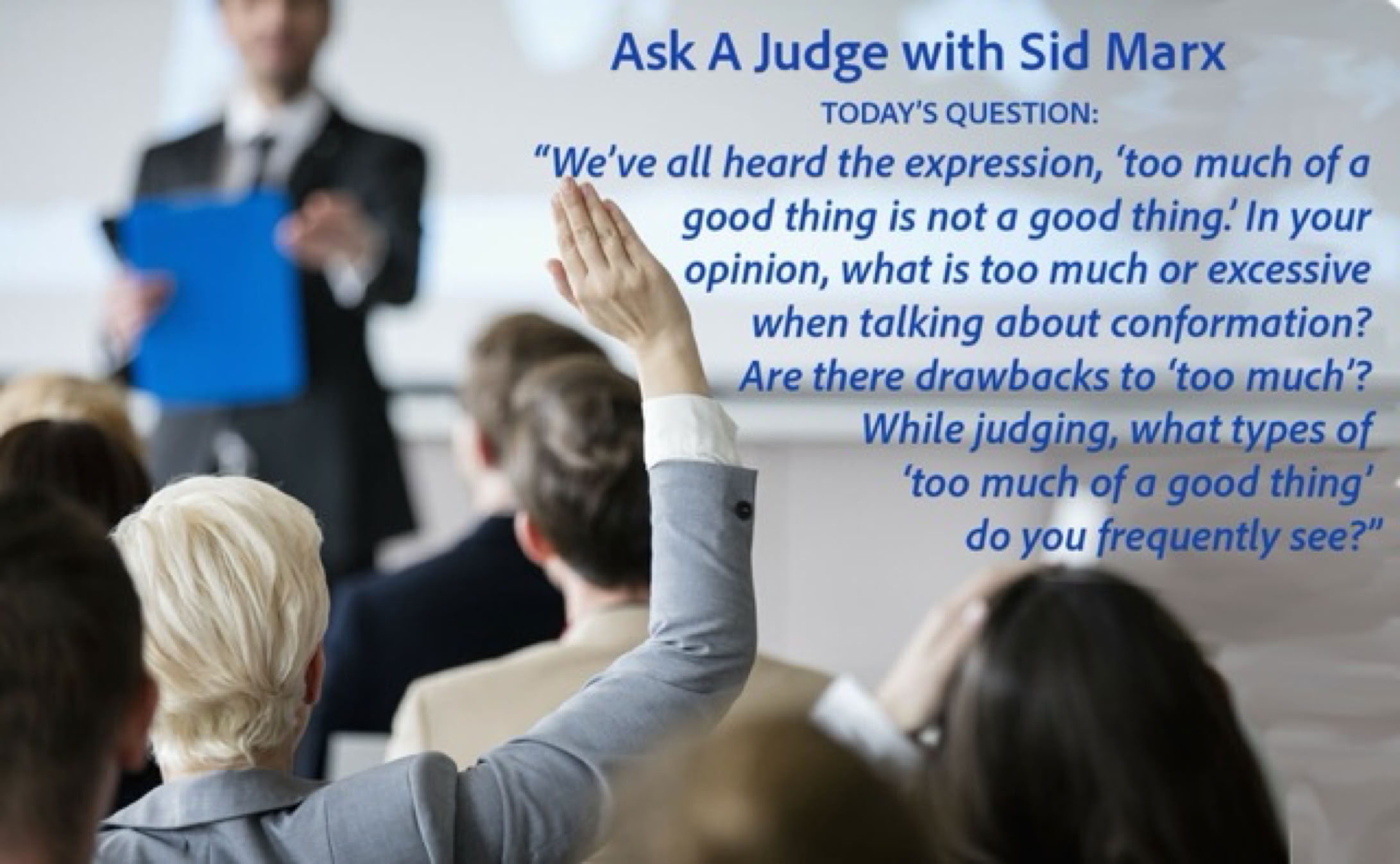
This is another excellent question. Almost every breed standard talk about avoiding extremes or imply the same thing. However, as in many things, people seem to think that if a little is good more must be better. Not so! The problems with extremes may be seen in the ring, but they are even more damaging in the whelping pen.
I will use a few breeds as examples for this discussion, but that absolutely does not mean that this problem is limited to these breeds. One of the most consistent weaknesses seen in the conformation ring is poor front assemblies – short upper arms that are too upright. Let me start with my breed as an example – Irish Setters. In 1962, the movie, Big Red, hit the big screen, and the beauty and temperament of the Irish Setter were introduced to the public. People would watch Westminster and other shows in the 1960’s and 1970’s and the beautiful, flowing red hair of the Irish captivated them. As with many breeds, the breed’s popularity grew, and it’s quality waned. Some rushed to breed this beautiful breed without having the requisite knowledge and passion to stabilize or improve the breed, unfortunately with the inevitable result.
Instead of The forelegs reach well ahead as if to pull in the ground without giving the appearance of a hackney gait, we saw dogs high-stepping around the ring, with beautiful coats flying – and spectators loved it. It didn’t take long for short, upright shoulders, and narrow chests to become ingrained in some lines of the breed. Many of you are much better breeders than I was, and I am sure you will agree with me that poor fronts are very difficult to correct in the whelping pen, as evidenced by how many breeds have been trying to do this for years. So, breeding for coat and flash has been a drag on the breed for years. Thankfully, there are good breeders who research health issues and proper conformation – and they are keeping our breed beautiful while improving proper structure.
For me, BALANCE is one of the most important traits a dog can have, and it is called for in most breeds. People mouth the words, “Tremendous Reach and Drive” without truly understanding its meaning or in what context it was originally said. First of all, not all breeds should have the same reach. Compare the German Shepherd movement to that of the Nova Scotia Tolling Retriever. This desire for tremendous has resulted in over-angulation in many breeds. When you combine the short upper-arms mentioned above with excessively angulated rears, the result is a dog with a rear that over reaches the front and often has sickle-hocks, often with the dog moving on his pastern in the rear. Sometimes flashy – never correct.
For some reason, exhibitors have decided that setting their dog up with an exaggerated sloping topline looks good. I have even heard people refer to it as the Irish Setter sloping topline. That drives me nuts. The Irish topline is firm and SLIGHTLY sloping. With very rare exceptions, your breed is probably the same or very level. The result is that exhibitors set the dog’s rear much too far back. Most dogs will fight this because they feel like they are slipping, and so you wind up struggling with the poor dog who is trying to stand correctly. That is one reason I pull dogs out and make the handler let the dog stand on his own so I can see the true structure.
Many breeds want a well-developed chest. Some breeders and exhibitors take this to an extreme. The Weimaraner standard says, “The chest should be well developed and deep.” A well-developed chest that is also deep and extends well back provides for great lung room, necessary for a breed to work long hours in the field. I did not see in any breed standard any words that require a dog to have s fore-chest so massive that it appears ready to fall forward. An exaggerated fore-chest results in a dog that is out of balance, and to me, that is a great no-no.
The person who asked this question also included excessive or over-handling in the question. I was taught by those in the past that a good handler was barely noticed. The job of the handler was to show the dog – not yourself. Being flamboyant might make you think you are working hard, but usually you are just getting in the way of me seeing your dog.
The same can be said of excess in grooming. There may be a few breeds that become grooming contests, but that doesn’t make it correct. Grooming should be done to accentuate strengths and help to conceal weaknesses – not to be the reason a judge points to your dog.
Exaggeration of any aspect of a breed – whether it be structural or excessive coat – detracts from the dog’s ability to fulfill its function. One question a judge should be asking himself as he looks at your dog is, “Could this dog complete its purpose” whether that be in the field or on your lap.
I hope that answers this question. Thank you for the opportunity for me to give you my opinion.
Most of us would agree the common metaphor, "Too much of a good thing is not a good thing" applies to almost everything in life. I would like to offer a GREAT BIG THANK YOU to judge Mr. Sid Marx for helping us to see how it applies to both our breeding programs and in the show ring as well.
You may also enjoy reading other great articles, both current and past, by Sid Marx in his column which appears in Dog News magazine and online, The Judge Marx the Spot at https://www.dognews.com/sid-marx-0
SHARE US WITH YOUR FRIENDS ON FACEBOOK