
UP YOUR DOG SHOW GAME
Helping Breeders &
Exhibitors Succeed in the Show Ring
GREAT QUESTION
UP YOUR DOG SHOW GAME
Helping Breeders &
Exhibitors Succeed in the Show Ring
GREAT QUESTION
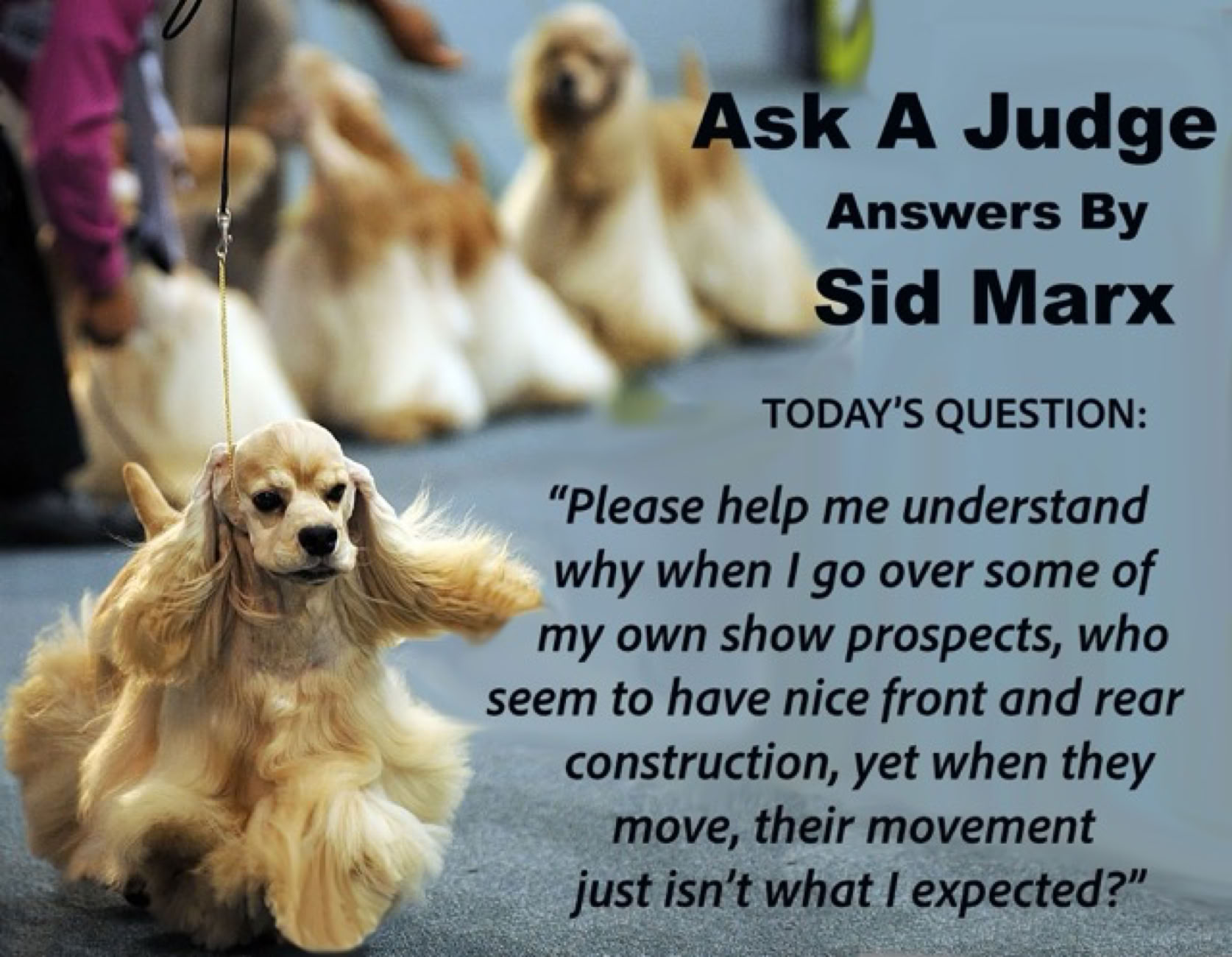
This is a question that judges ask themselves as they examine almost every dog. I have even realized that when I thought I was saying to myself, “Please let this dog move well,” on occasion I have mistakenly said it out loud. What we know – or think we know – about anatomy and the construction of a dog, sometimes is proven out when the dog moves – and this is as it should be, but at other times, it is like we are looking at two different dogs.
What does a “nice front and rear end construction” mean? I think we would all agree that a “well laid-back” shoulder, a “proper (not sunken or exaggerated)” fore-chest, and (usually) equal length shoulder blade and upper arm would be considered a “nice front.” A rear that has “equal” angles as that of the front assembly, with short hocks would probably be considered a “good rear assembly.” A dog with this structure could reasonably be expected to move well. And so, when this dog moves with no front reach, or drive behind, or even sidewinds, it seems to defy reason.
Let’s take it a step forward. A judge examines a dog and feels an upright, straight front. He then moves to the rear and finds very little angulation there. And yet, this dog moves better than the one described in the previous paragraph. What’s the explanation? There is more to anatomy than just bone structure. The importance of musculature, tendons, conditioning, and training all affects a dog’s movement.
Balance is of extreme importance – not just for correct movement, but for the protection of the breed. So, a dog that is straight front and rear, is in some degree of balance, and thus, he may move decently. Balance also refers to soundness in mind and body, and this also can affect movement.
I think there needs to be a harmony between the handler and dog as they move. Kaz described it as a dance. Sometimes dogs move poorly because the handler is tugging back on it with every step.
There are many things that affect a dog’s movement, and as important as a proper front and rear assembly is, so is balance. And remember, we are judging – and protecting – our breeds, so movement is just a part of it. Topline, silhouette, balance – as well as breed nuances – all come into play. As always, when judging, everything is a trade-off. I would never put up a poor breed specimen just because he moves well, or a beautiful dog who did not display a degree of soundness. It is THE WHOLE we should be looking for.
I hope that helps. Enjoy your dogs.
Once again we'd like to thank Sid Marx for helping breeders and exhibitors understand how many judges evaluate the dogs we show them!
You may also enjoy reading other great articles, both current and past, by Sid Marx in his column which appears in Dog News magazine and online, The Judge Marx the Spot at https://www.dognews.com/sid-marx-0
SHARE US WITH YOUR FRIENDS ON FACEBOOK