
UP YOUR DOG SHOW GAME
Helping Breeders &
Exhibitors Succeed in the Show Ring
GREAT QUESTION
UP YOUR DOG SHOW GAME
Helping Breeders &
Exhibitors Succeed in the Show Ring
GREAT QUESTION
Ask A Judge
Answers By Sid Marx
TODAY’S QUESTION:
“I hear the phrase 'form follows function’ mentioned occasionally amongst some judges and old-time breeders. What does it mean?”
Unfortunately, there are a number of terms that we use liberally that may not be universally understood, although they should be. I remember attending a breed seminar for a Hound breed that was also attended by many breeders. When one of the slides on the screen was about angulation, there were a lot of blank stares from a few of the breeders in attendance, and finally, one of the presenters asked me to come to the front and explain the meaning of angulation – which I did. To be honest, I was very surprised that some successful breeders in the audience did not understand this important aspect of our dogs.
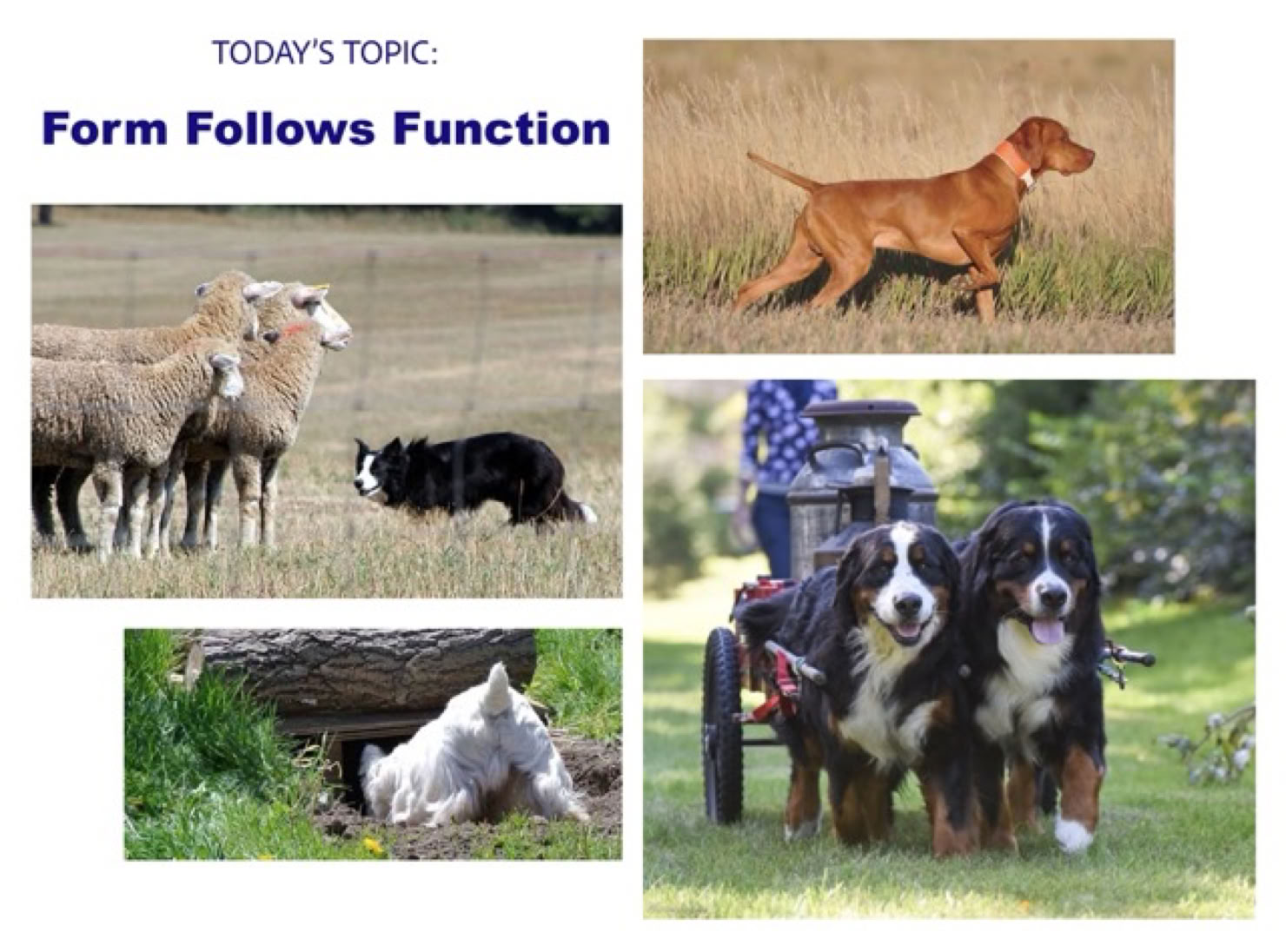
I think you could basically say that form follows function is at the root of what our dog show community is all about. In architecture, the term means that the shape of the building or structure should fit the purpose of that building. It’s a principle that means you should not try to fit a square peg into a round hole. Every breed standard is essentially built around this principle.
Basically, for our community, form follows function means that a dog is built – his structure and temperament – to enable him to perform the function of the breed. Very simply, if you look at how a Pekingese is built, you would never expect its function to be running in the field to locate birds or rabbits. You would not expect a Chihuahua to retrieve a duck or hare.
When a judge studies a breed, part of what he learns is the dog’s history and function. Many breeds offer opportunities for judges to observe the breed actually performing its function – whether that be hunting in the field, tracking, or as a protector – and this can truly help a judge in his understanding of that breed – and it should help him to understand WHY the dog has to be built in a certain way to perform its function (job).
Watching how far afield a Brittany runs as he hunts, or how a Pointer or Setter holds (sets or points) the bird, would help you understand that they need to be built differently from a flushing spaniel who works closer to the handler, and then flushes the birds. A Clumber Spaniel works in heavier cover than does a Cocker Spaniel, so it has to be built stronger and heavier. If you watch how an English Cocker Spaniel almost pounces into the brush to force the bird to fly, you understand why his haunches have to be well-muscled – or what is sometimes called “cockery.” Although each of these breeds has to be structurally sound (good feet, substance, proper angles and layback, strong topline), the nuances of their function, demands that each be built differently.
In its purest form, when a judge examines and watches a dog move, he is trying to determine the dog’s form, and whether this form will enable it to perform its function. This is often where a judge has to make a decision on trade-offs. What if a judge of a sporting (hunting) breed feels and sees good shoulder layback and rear angulation on a dog – and this form says that the dog should be able to move smoothly and easily – but then the dog moves poorly, with little reach, poor foot-timing, and seems to be laboring? What if he crosses in the front or the rear legs practically hit against each other? Could this dog run and hunt all day without breaking down? Would the hunter wind up carrying the dog out of the field? This dog could not perform its function even though his form says he should be able to. Maybe it is a lack of musculature or laziness, or the dog is forced to move like this because of the handler. What does the judge do? And so, you have the essence of judging – everything is a trade-off.
So, to be brief (too late for that), form follows function means that a dog should be built to enable it to perform what that breed is supposed to do. Toy breeds are basically designed to be lapdogs, so we certainly don’t expect them to move with the same drive and reach that we would expect from a Herding breed, whose function requires it to be very agile, quick, and move with alacrity to keep the cattle or sheep or whatever moving in the direction that the shepherd desires.
Form follows function. I hope this helps.
Enjoy your dog.
———————
In a sport that is seemingly only interested in the win, thank you Judge Sid Marx for reminding breeders, exhibitors and breed clubs that the phrase "form follows function" is what should be at the forefront of every breeding program.
For those who desire to learn more on this invaluable subject, here is a book we suggest:
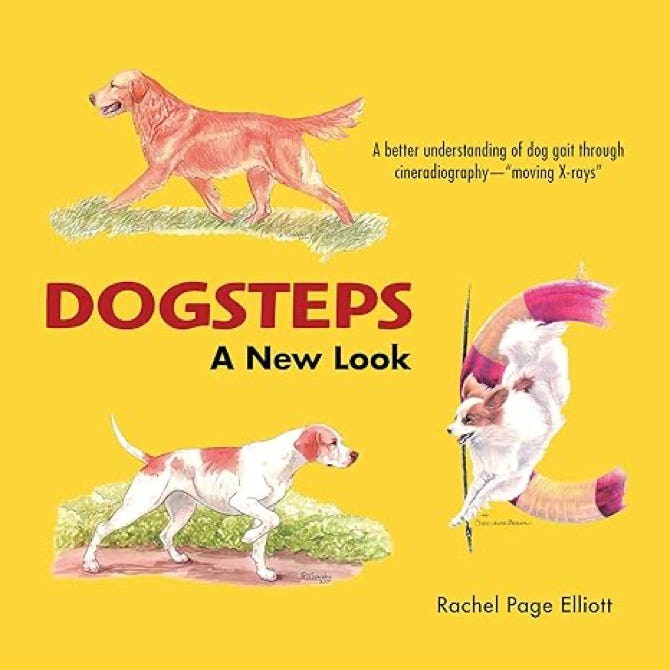
Dog Steps, A New Look by Rachael Page Elliott, 3rd edition (2014)
Definitive Manual to Canine Movement, Dog Anatomy, and Natural Gaits of Purebred Dogs; for Breeders, Judges, and Anyone Wanting to Show Dogs.
More than an analytical look at the canine gait, this 144-page guide teaches the details of dog anatomy and how each body part contributes to correct movement. In the show ring, judges evaluate a dog's movement to determine whether the dog is correctly structured. Dogsteps explains what the judge is looking for in layman's terms, making this book essential for breeders, judges, exhibitors, and students of purebred dogs.
This informative resource begins by explaining the terminology often used in descriptions of dog anatomy (stop, occiput, withers, hock, croup, etc.) and showing three comparative skeletons (dog, horse, and human), pointing out the critical similarities and differences. The author describes the eight natural gaits of dogs and how each is accomplished in specific breeds: walk, amble, pace, trot, hackney gait, suspension, canter, and gallop. Real science is applied, and myths are busted (such as the myth of the 45 degree shoulder), to help even a novice understand the biomechanics of walking in dogs.
Individual chapters are devoted to the topics of angulation, toplines and tails, front assemblies, and shoulder assemblies. Each chapter is illustrated with helpful drawings that act as "moving x-rays" to give you a clearer picture of how each anatomical region affects the dog's gait, pointing out common flaws, the importance of correct structure, and how balance and ease of movement are achieved in a properly put-together dog.
SHARE US WITH YOUR FRIENDS ON FACEBOOK